

Most digital records do not need anything special.
An email confirmation is usually enough. So is a shared folder, a company database, or a PDF saved by both sides.
The interesting cases start when something goes wrong.
Consider a moving company handling valuable household items.
Before packing, the crew photographs their condition and prepares a report. Some companies may already use AI-assisted image tools to organize the photos, identify items, or draft descriptions. The completed report is emailed to the customer and to the moving company’s office.
At the destination, the same process can happen again as important items are unpacked.
If everything arrives safely, those reports may never matter again.
But suppose a television is cracked. A table is scratched. An expensive item is missing.
Now the customer, the moving company, and perhaps an insurer all want to know the same thing:
What was actually documented before the move?
That is when it helps to have a record neither side controls.
The moving company can still create and store the report exactly as it does today. The customer can still receive a copy by email.
The difference is that an independent proof of the completed report can also be created.
A simple way to do that is to calculate a hash of the file and record that hash on a public blockchain.
A hash is a short code calculated from the exact contents of a file. Change the file, even slightly, and the hash changes too.
The report itself does not need to go onto the blockchain. The photos stay private. Names and addresses stay private. The file stays where it already belongs.
Only its hash is used to create the public proof.
Once that hash has been recorded, neither the customer nor the moving company can quietly substitute a different report later. ProofStamp cannot rewrite the record either.
Anyone with a copy of the report can calculate its hash again and compare it with the public record.
The same math works for everyone.
What the proof actually proves
The proof is deliberately narrow.
It does not decide who damaged the television. It does not decide whether an AI-generated description of a photograph was correct. It does not declare that everything written in the report is true.
It answers a much simpler question:
Is this the same file that was recorded at that time?
For many disputes, that alone can be useful.
Instead of arguing about which version of a report existed before the move, both sides have something independent to check.
The best proof may never be used
There is another benefit.
The existence of an independent record can change behavior before any dispute starts.
If both sides know that the original report was recorded outside either party’s control, there is less room to adjust the story later. The moving crew has a reason to document carefully, and the customer has a reason to review the report while the condition of the items is still fresh.
If something goes wrong, everyone knows the earlier file can be checked.
That does not make people magically honest. It changes the incentives.
Better incentives can mean fewer questionable claims, fewer arguments, less time spent reconstructing what happened, and fewer unnecessary insurance disputes.
In practical terms:
less time, less money, fewer nerves.
The best proof may be the one nobody ever has to use.
Making the public record feel ordinary
This is what ProofStamp via Arbitrum is experimenting with.
The process is intentionally simple:
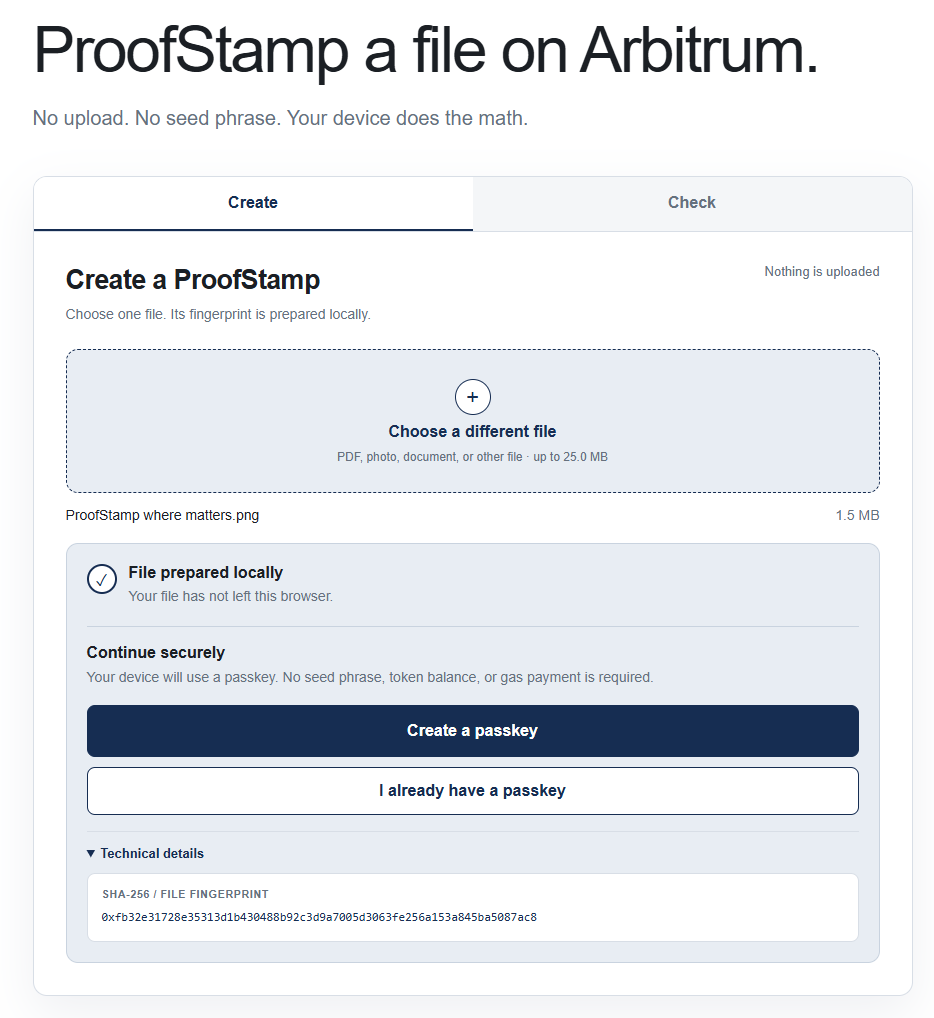
choose a file → use your passkey → create the proof
The file stays in the browser. Its SHA-256 hash is calculated locally on the user’s device, and the file itself is not uploaded to ProofStamp.
The hash is then used to create a record on Arbitrum.
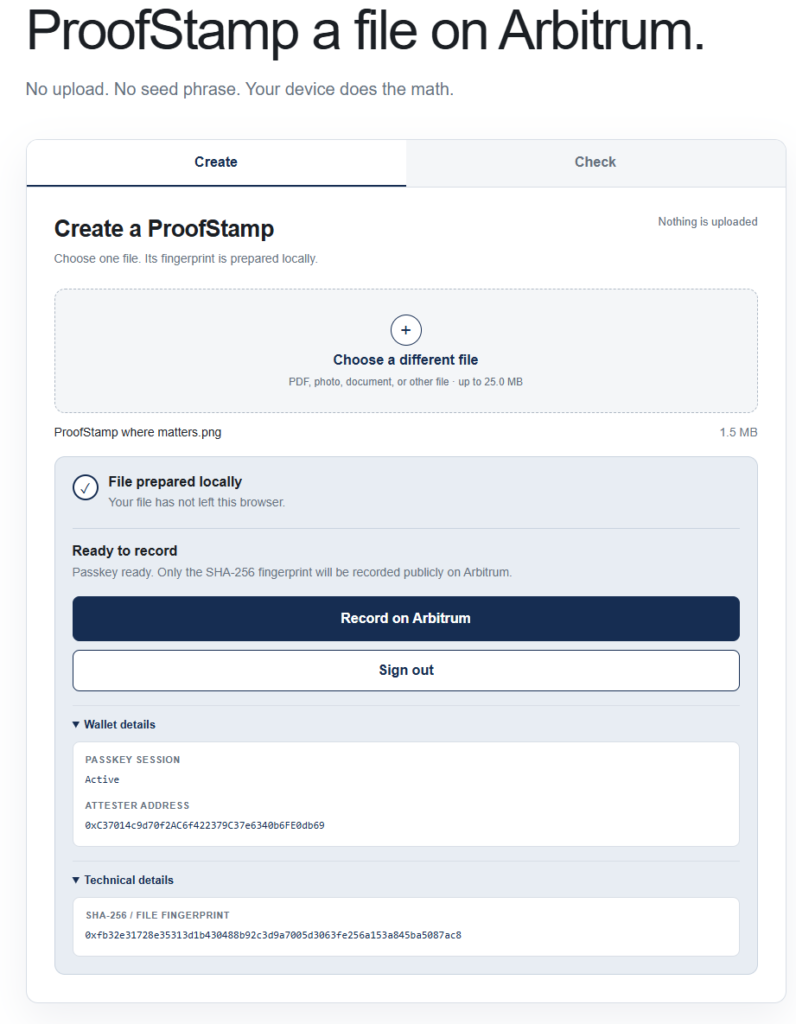
Later, the same file can be checked against that record.
The report itself can still be handled normally: emailed to the customer, stored in the moving company’s system, or attached to an insurance claim if necessary.
The blockchain is not replacing any of those tools.
It adds one thing they normally cannot provide on their own:
a reference that neither party gets to control.
Why this is becoming practical now
Public blockchains have been able to create this kind of shared record for years. The difficult part was using them.
A normal user was expected to create a special account, protect recovery words, obtain network tokens, understand transaction fees, and approve unfamiliar transactions.
For most people, that was enough reason not to bother.
Much of that machinery can now stay in the background.
With the current implementation, the user chooses a file, authenticates with a passkey, and creates the proof. Transaction costs are handled behind the scenes.
The blockchain still does the work. The user no longer has to operate it.
That changes where the technology can reasonably be useful.
Not every email, photo, or document needs a public proof. Most do not.
But sometimes two parties may disagree later, and neither should have complete control over the historical record.
That is where a public blockchain starts to make sense.
The receipt can be kept and shared. The underlying record can also be inspected independently through public Arbitrum and Ethereum Attestation Service tools.
Verification is not limited to the ProofStamp website.
There is no private ProofStamp database holding the original file behind the scenes.
If the ProofStamp website disappeared, the public record would still be there.
That is the point.
Create a proof with an important file and see how independent verification works.
The current ProofStamp via Arbitrum implementation runs on Arbitrum Sepolia testnet.