
A law firm transfers a case to another team.
The handover includes photographs, expert reports, correspondence, and the metadata needed to understand those files.
Years later, someone produces a different copy of one photograph. The team can compare it with the hash recorded during the handover, assuming that record was preserved.
But another question remains: Can they establish that this exact version existed when the case was handed over?
A matching hash can provide strong evidence that two files have the same bytes. It does not establish when those bytes existed. Anyone can calculate a hash today. Independent time evidence may answer that second question.
Legal software already knows how to preserve files
Hashing is established practice in digital evidence handling. RelativityOne records SHA-256 hashes for processed native files. Everlaw’s production templates include hash metadata. Neither example needs a new hashing feature.
The National Institute of Standards and Technology recommends storing evidence hashes separately from the files under appropriate controls. And Spellbook’s Autonomous Contract Management illustrates how software can keep contract versions and deal history together.
These capabilities are already useful. The question is whether selected records would also benefit from a time checkpoint that can be verified independently of the platform that created it.
Give important files an independent time checkpoint
Consider the litigation handover again.
When the firm finalizes the package, its software could calculate the SHA-256 hash of each selected file and obtain an independently signed timestamp for that hash. The firm would retain the files and verification material together.
The proposed workflow is simple:
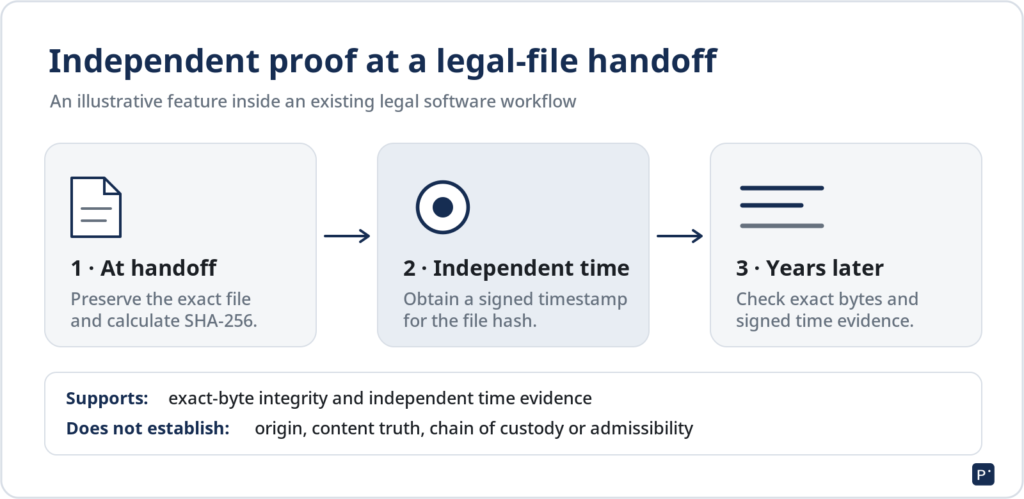
Years later, someone with that file and its proof could check whether the bytes match the independently timestamped hash, without accessing the original litigation platform.
An RFC 3161 signed timestamp provides evidence that the bytes represented by the hash existed no later than the signed time. It does not establish when a photograph was taken, who took it, or whether it was edited before the timestamp. Source records, collection procedures, and chain of custody still matter.
Even a visually identical image can fail an exact-byte comparison after ordinary conversion or reprocessing. A mismatch alone does not establish dishonest alteration.
Where would this actually help?
Not every legal file needs another cryptographic record. A digitally signed document may already carry suitable integrity and time evidence. Existing case systems may already meet the customer’s needs.
The potential value is at selected handoffs or approvals: an evidence package transferred to another team, an expert report finalized before circulation, or an unsigned contract version preserved for external review.
For legal-tech companies, the benefit worth testing is straightforward. A customer could retain independent time evidence alongside an important file. A future lawyer, auditor, or other reviewer could check that exact file without needing an account with the original provider or access to its audit logs.
The platform would still manage documents, versions, permissions, and activity. Independent verification would complement those functions, particularly after records have been exported or the customer has changed providers.
There are legal limits. In the United States, Federal Rule of Evidence 902(14) provides an authentication procedure for certain copied electronic data using digital identification, qualified certification, and notice. A timestamp alone does not satisfy that procedure or guarantee admissibility.
A September 2026 submission to the U.S. Advisory Committee on Evidence Rules proposes recognizing public-blockchain timestamps in the authentication of digital evidence. It raises a related question about independent proof, but concerns a different timestamping method from RFC 3161. It remains a proposal, not an adopted federal rule.
A practical question for legal-tech builders
At ProofStamp, we are exploring how independent verification could become an ordinary feature of software people already use.
Legal-tech providers could implement the approach themselves using established cryptographic standards, without requiring lawyers to adopt another application. The real product decision is which records deserve an independent checkpoint and whether customers find enough value in retaining that proof.
Existing hashes, signatures, and audit trails already answer many questions. Independent time evidence could answer one more, even after the original software is no longer available.
Could your customers verify an important file years after they stop using your platform?
This is an independent ProofStamp concept, not a live integration, endorsement, or legal certification service.