
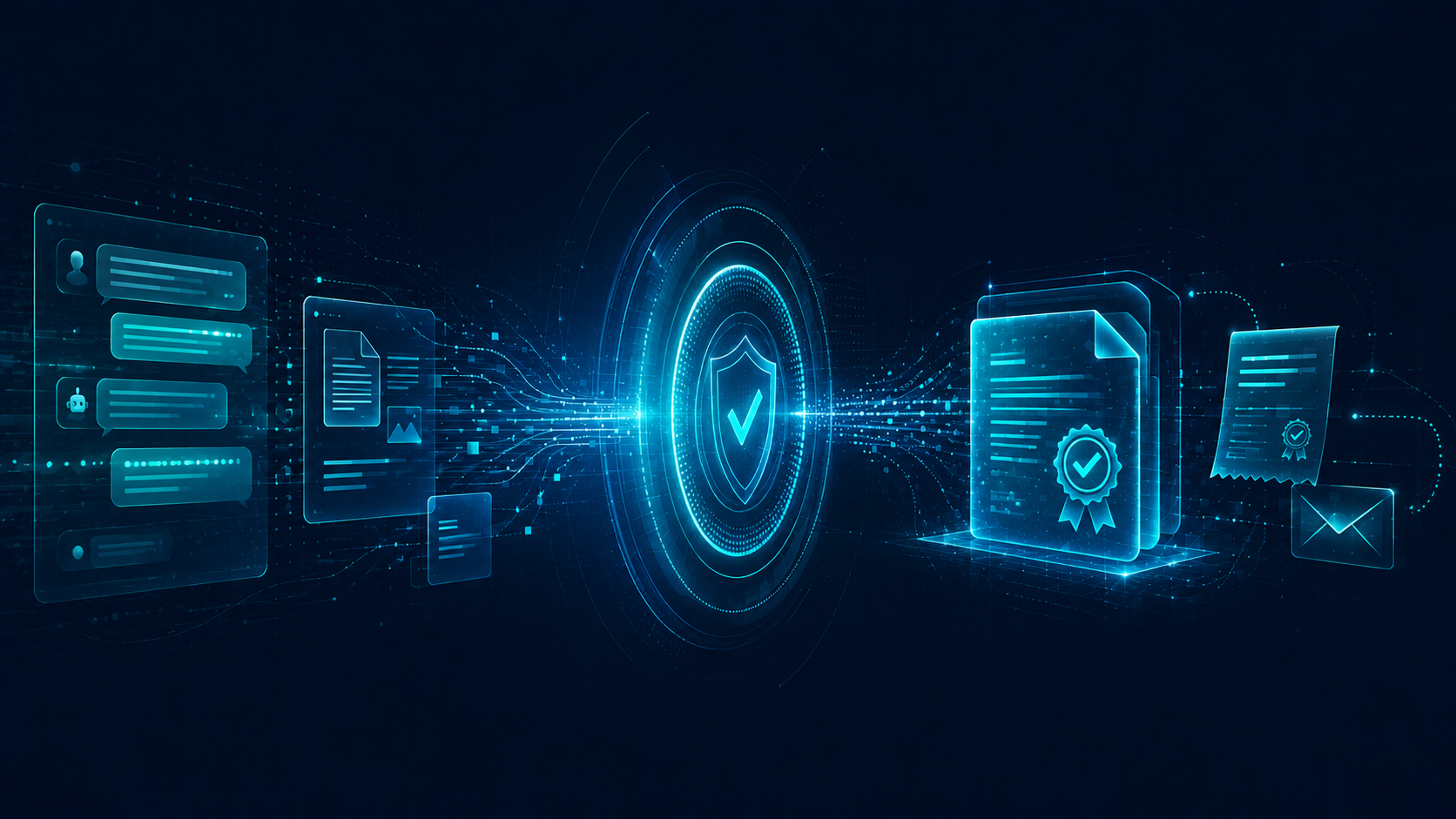
AI is becoming part of ordinary professional work. People use ChatGPT, Claude and other AI tools to research questions, analyze documents, investigate problems and prepare advice.
Sometimes the conversation itself matters.
If an AI interaction influenced an important decision, could you show later what you relied on? And could someone check that the record you kept has not changed?
Saving the conversation is the first step. Making that saved record independently verifiable is the second.
Save the record, then verify the file
Imagine you use AI to research an unusual clause in a contract. You ask questions, challenge some of the answers, review sources and eventually use part of the analysis in your work.
Six months later, someone asks what you relied on.
A screenshot may help. So might a copied transcript or a shared chat link. But none of those, by itself, gives someone a simple way to check whether the file you are showing now is the same file you preserved earlier.
ProofStamp AI gives the saved record a cryptographic fingerprint using SHA-256.
SHA-256 takes the exact bytes of a file and produces a fixed-length fingerprint. The same bytes produce the same fingerprint. Change the file, even slightly, and the fingerprint changes.
If you want the underlying idea in plain English, see What Is a Hash Function? SHA-256 Explained.
ProofStamp calculates the fingerprint of the saved AI record, then reads the saved file again and calculates it again. If the values match, the fingerprint corresponds to the exact file that was saved.
Suppose the fingerprint recorded today is:
8c47...f92a
Months from now, calculate SHA-256 on the file again. If you still get 8c47...f92a, the bytes match.
If a question was edited, an answer deleted, a source changed or anything else in the file modified, the fingerprint would be different.
You do not need ProofStamp to tell you whether it matches. SHA-256 is an open standard, so the check can be repeated independently.
Email adds a time record
A fingerprint tells you about the file. By itself, it says nothing about when that fingerprint existed.
ProofStamp therefore prepares an email after the file has been verified. The email contains the fingerprint, filename, file size and verification information.
You send it yourself, perhaps to your own inbox, a colleague, a client, counsel or another mailbox you control.
The receiving email system records when the message arrived. That gives you external evidence that the fingerprint existed no later than the email system’s recorded receipt time.
If the file is questioned later, you can compare its current SHA-256 fingerprint with the fingerprint preserved in that earlier email.
This is the same basic idea behind ProofStamp via email. You can also verify a saved ProofStamp file in your browser.
For the user, the workflow is deliberately simple:
Have the conversation. Say “ProofStamp this session.” Save the record and receipt. Send the prepared email.
No ProofStamp account is required. The conversation does not need to be uploaded to a ProofStamp server, and there is no central archive you have to trust.
You keep the files.
Integrity is not completeness
A file can be perfectly unchanged and still contain only part of a conversation.
ProofStamp therefore records capture completeness separately from file integrity.
If the AI environment provides affirmative evidence that everything inside the defined capture scope was available and included, the record can say complete. If something known to be in scope is missing or truncated, it says partial. If there is no reliable way to establish either, it says unknown.
For some AI environments, unknown will be the correct result.
A record should not claim to be complete simply because the model thinks it can see the whole conversation.
What the record establishes
A matching fingerprint tells you that the file being checked now has the same exact bytes as the file represented by that fingerprint.
An earlier email can add evidence that the fingerprint existed by the receiving system’s recorded time.
The fingerprint does not tell you whether the AI was correct, whether every statement is true, who authored the content, or whether the AI provider certified the conversation. It also does not prove when the underlying conversation originally happened or automatically make the record legally admissible.
A hash should not be asked to prove more than a hash can prove.
If the conversation matters, preserve it
The interesting question is not simply whether AI was used.
It is whether, later, you can show what you relied on and check that the record you preserved has not changed.
If an AI conversation may matter later, preserve it while you still have it.
That is the idea behind ProofStamp AI.
If an AI conversation matters, ProofStamp it before you close it.
For more background on how ProofStamp works and where it can be useful, see ProofStamp Learn.